
Pigmentation treatment
Rough, Scaly Patch or Age Spot? Why Sun-Damaged Skin Is Checked Before Pigment Laser
Information to help you prepare questions. Treatment suitability, risks and aftercare are assessed individually with the clinic.
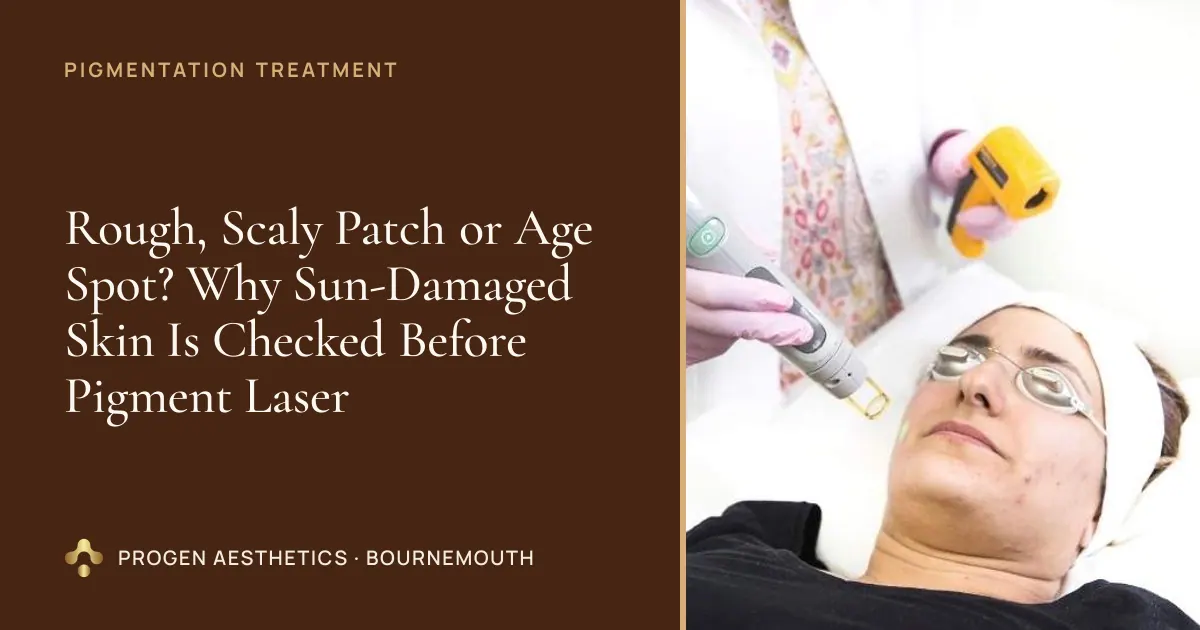
An age spot (solar lentigo) is usually flat and smooth. An actinic keratosis (AK), a sun-damaged patch that a clinician assesses, more often feels rough, dry or scaly, but the two can look alike, especially when the patch is brown. If you cannot tell which you have, or a mark is new, changing, sore or bleeding, a GP or dermatologist should look at it before any cosmetic treatment. If a mark is confirmed as a harmless age spot, you can then ask about pigmentation removal in Bournemouth.
How an age spot and an actinic keratosis usually differ
| Age spot (solar lentigo) | Actinic keratosis | |
|---|---|---|
| Feel | Smooth and flat | Often rough, dry or scaly; some are felt more easily than seen |
| Colour | Brown | Skin-coloured, pink, red or brown |
| Where | Sun-exposed skin | Sun-exposed skin: face, ears, scalp, hands, arms, lower legs |
| Meaning | Harmless | Usually not serious, but a small number can become skin cancer |
Harvard Health describes age spots as "smooth and flat" and actinic keratoses as usually feeling "rough and scaly". The NHS describes AKs as "dry, scaly patches of skin that have been damaged by the sun" that can feel like sandpaper, range from skin-coloured to pink, red or brown, and are usually 1 to 2 cm across. The British Association of Dermatologists' patient information on the PCDS site says most AKs are generally harmless, with a very small risk of progressing to squamous cell carcinoma, and that people with many lesions or a weakened immune system are most at risk.
Texture helps, but it is not proof. The Skin Cancer Foundation says pigmented AKs can resemble age spots or seborrhoeic keratoses and may need a biopsy to confirm. It also says a foundation or concealer that goes on flaky around the eyes can be a clue. You cannot confirm it from home.
Why the label matters before laser
Melanin-targeting lasers are used on harmless age spots. The concern is a look-alike that is not harmless:
- A 2026 study in the Journal of the German Society of Dermatology compared a market-approved computer tool with dermatologists on 100 biopsy-confirmed flat pigmented lesions of the face and scalp, including solar lentigo, pigmented actinic keratosis and lentigo maligna. The authors note that these look similar and that laser treatment of a lentigo maligna could delay diagnosis. Dermatologists looking at dermoscopy images alone averaged 66.7% accuracy, rising to 73.6% with expanded case information. Even specialists find these lesions hard to separate, which is why a visual guess is not enough.
- A 1998 case report in the Journal of the American Academy of Dermatology described two atypical-looking "age spots" treated with a Q-switched ruby laser. Both first looked improved, then pigment came back. A biopsy showed lentigo maligna melanoma in one and early lentigo maligna in the other. The authors concluded that melanin-targeting lasers may not clear such lesions and urged careful assessment first. This is two cases from an older laser, so it shows why caution exists, not how often it happens.
Neither source says that laser harms every pigmented AK, and neither says Progen's laser has been tested on these conditions. The point is the order: diagnosis first, then any cosmetic plan.
When to see your GP first
The NHS advises non-urgent GP advice if you notice new patches, or a patch that bleeds, grows, changes colour, becomes tender, turns into a lump, or is on your lips. NI Direct adds a visit if you have had AKs before and think you have a new one. For a dark mark that is changing, see why a dark spot is checked before laser pigmentation treatment.
Treatment of a confirmed AK is a medical decision. The NHS says a GP may suggest waiting to see whether a single patch clears, while more than one patch, or one that is sore or itchy, usually leads to treatment such as creams, freezing or photodynamic therapy. The PCDS leaflet says up to 25% of AKs resolve without treatment. DermNet says the risk of squamous cell carcinoma in someone with more than 10 AKs is thought to be about 10 to 15%, and that a single AK turning into cancer is rare. Your own risk depends on your skin and history, so ask your clinician.
What to bring to a check
- When you first noticed the mark, and any change in size, colour, feel or surface.
- Whether it itches, stings, crusts or bleeds, and whether skincare such as retinol or acids makes it sting.
- Any past AKs, skin cancers, or a weakened immune system.
- Photos taken in the same light over time, if you have them.
If the mark is confirmed as a harmless age spot
Your practitioner will confirm whether laser pigmentation treatment suits your skin tone, recent sun exposure and the mark itself. For related reading, see seborrhoeic keratosis or age spot for raised, stuck-on marks, and freckles vs sun spots: laser and recurrence for which flat marks laser can lighten and whether they return. Daily sun protection is the NHS and NI Direct advice for lowering the chance of new sun-damaged patches.
Frequently asked questions
Can I tell an age spot from an actinic keratosis by touch?
Touch gives a clue: age spots are usually smooth and flat, while actinic keratoses often feel rough or scaly. It is not reliable on its own, because pigmented actinic keratoses can look like age spots and may need a biopsy to confirm. A clinician should assess any mark you are unsure about.
Is an actinic keratosis cancer?
No. The NHS describes actinic keratoses as not usually serious, but a small number can turn into skin cancer, which is why new, changing, bleeding or tender patches should be seen by a GP.
Should I see a GP before booking laser for a brown mark?
If the mark is new, changing, rough, sore, bleeding or you are unsure what it is, see a GP or dermatologist first. If it has been confirmed as a harmless age spot, you can then ask a clinic whether laser pigmentation treatment suits you.
Can actinic keratoses go away on their own?
The PCDS patient leaflet says up to 25% resolve without treatment. A GP may suggest waiting for a single patch, but should review anything that persists or changes.
Ask about laser pigmentation treatment in Bournemouth once a mark has been checked
Sources and further information
- AKs are dry, scaly, sun-damaged patches, skin-coloured to pink, red or brown, usually 1-2 cm, can feel like sandpaper; GP advice for new, bleeding, growing, colour-changing, tender or lump patches or on the lips; treatment options; single patch may be watched.
- Most AKs generally harmless, very small risk of progressing to SCC, those with many lesions or immunosuppression most at risk, up to 25% resolve without treatment.
- Age spots are smooth, flat and harmless; AKs usually feel rough and scaly and should be shown to a doctor.
- Pigmented AKs can resemble age spots or seborrhoeic keratoses and may need a biopsy; concealer going on flaky can be a clue.
- GP visit for new patch after prior AKs, fast growth, pain or bleeding; sun protection advice.
- Risk of SCC with more than 10 AKs is thought to be about 10-15%; solitary AK progression rare; tender, thickened, ulcerated or enlarging lesions suspicious.
- Reader study of 100 histologically confirmed flat pigmented face/scalp lesions: dermatologists 66.7% (dermoscopy alone) and 73.6% (expanded information) accuracy; authors note laser of lentigo maligna could delay diagnosis.
- Two atypical solar lentigines treated with Q-switched ruby laser later proved to be lentigo maligna (melanoma in one); melanin-targeting lasers may not eliminate such lesions.
More in pigmentation
Questions people ask next
- Laser or Chemical Peel for Sun Spots and Age Spots: How They Differ
- Tinted Sunscreen for Melasma: Does Iron Oxide Add Anything to Regular SPF?
- Freckles or Sun Spots: Which Marks Laser Can Lighten and Which Come Back
- Pigmentation Darker After Laser: Healing Changes or PIH?
Treatment details, suitability and booking: pigmentation removal in Bournemouth. All pigmentation guides
Make an informed next step
Bring your questions
to a consultation.
A guide can help you prepare. Your assessment determines which options are appropriate for you.