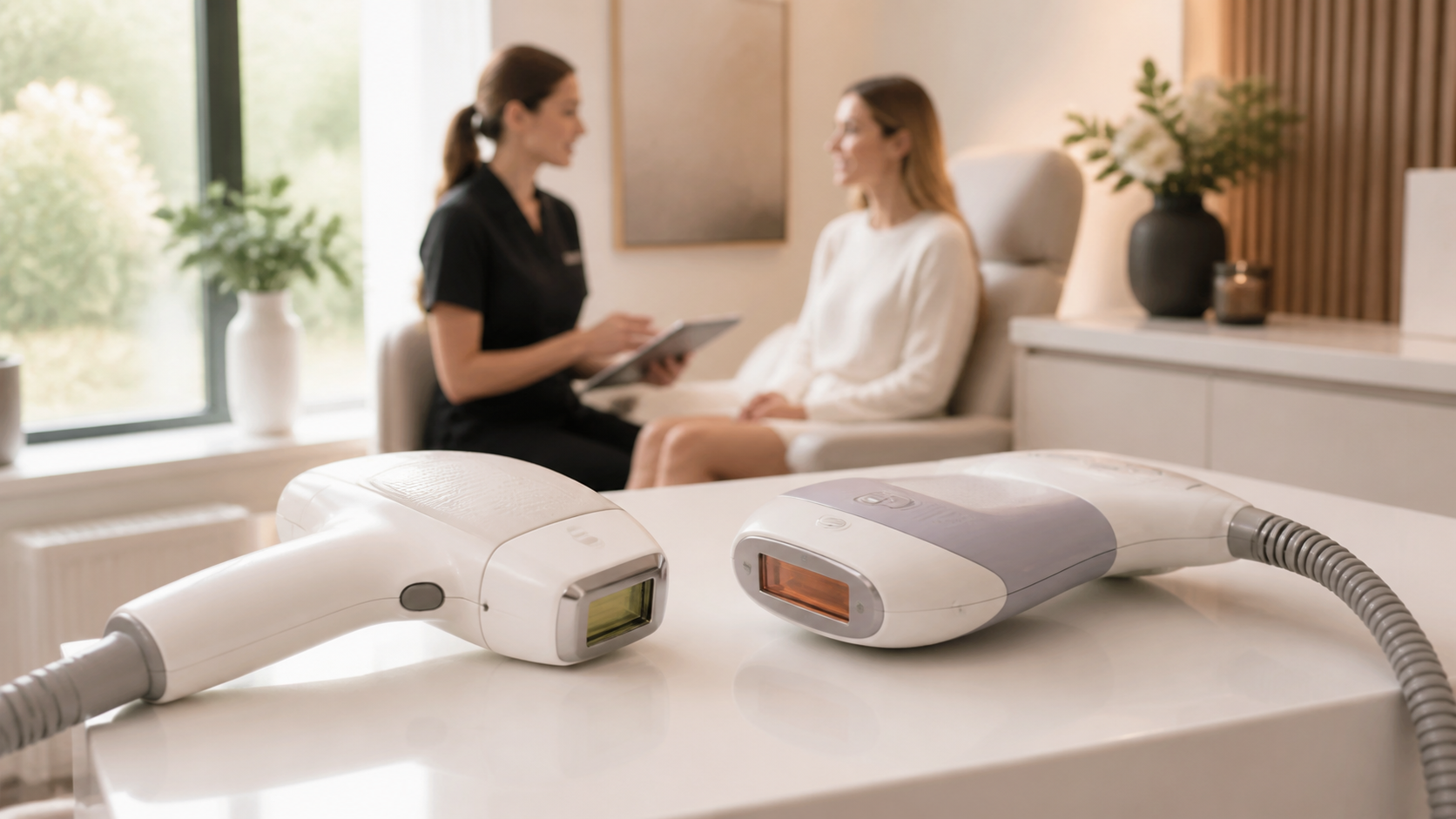
A laser emits a specific wavelength of light. Intense pulsed light (IPL) uses a broader spectrum filtered for the task. That distinction matters, but safe and effective hair reduction also depends on your skin, hair, history, the exact platform and the person operating it.
Laser vs IPL: the short answer
| Question | Laser | IPL |
|---|---|---|
| Light delivery | A specific wavelength | A broad spectrum shaped by filters |
| Device choice | Different laser wavelengths suit different clinical uses | Different platforms and filters vary in capability |
| Suitability | Depends on skin, hair, area, wavelength and settings | Depends on skin, hair, area, filters and settings |
| Course planning | Usually a course with response-led review | Usually a course with response-led review |
| Best decision | Made after an individual consultation—not from the technology name alone | |
A peer-reviewed review indexed by PubMed discusses both laser and IPL systems for long-term hair reduction and highlights the importance of device selection and complications. Read the review abstract on PubMed.
What is the practical difference?
Laser: a targeted wavelength
A laser platform uses a defined wavelength. Progen Aesthetics uses Candela GentleMax Pro Plus, which combines 755 nm Alexandrite and 1064 nm Nd:YAG. These are distinct wavelengths with different absorption characteristics; the practitioner selects an approach based on the individual assessment.
IPL: a broader spectrum
IPL is not a laser. It produces a broad spectrum of light and uses filters to narrow the range delivered. IPL platforms vary, so “IPL” on its own does not tell you enough about capability, maintenance, calibration or the operator’s training.
Do not compare a category label with a marketing claim. Compare the actual device, why it is being recommended for you, who will operate it and how your response will be reviewed.
Which hair and skin combinations need extra care?
Light-based hair reduction relies on pigment in the hair absorbing energy. Very light blonde, white, grey and some red hair may respond poorly because there is less target pigment. Darker skin tones can be assessed for treatment, but wavelength, settings, cooling and practitioner experience are especially important.
The American Academy of Dermatology explains that laser hair removal can be performed across skin tones when the practitioner has appropriate experience, and it advises avoiding treatment over tanned skin. Read the AAD patient overview.
Tell the practitioner about:
- recent sun exposure, tanning or self-tan;
- medicines, supplements and topical products;
- skin conditions, scarring or pigment changes;
- hormonal conditions or unexplained hair growth;
- previous reactions to laser, IPL or heat-based treatments;
- the hair-removal methods you currently use.
This information does not automatically rule treatment in or out. It helps the practitioner decide whether to proceed, modify timing, patch test, request further advice or recommend an alternative.
Seven questions to ask at your consultation
- Which device and wavelength or filter will you use?The answer should identify the platform, not just say “medical grade”.
- Why is it suitable for my skin, hair and treatment area?Look for an individual explanation rather than a universal claim.
- What result is realistic?Ask about likely reduction, limitations and possible maintenance.
- What are the relevant risks and common reactions?You should understand expected short-term effects and when to contact the clinic.
- Will I need a patch test?Ask what the test checks and how long you should wait before treatment.
- What must I avoid before and after appointments?Sun, tanning, hair-removal methods, products and activities may affect timing.
- How will progress be documented and reviewed?A course should respond to your skin and hair, not run on autopilot.
Choosing a clinic in Bournemouth, Poole or Christchurch
Convenience matters when a treatment requires repeated visits, but it should not be the only criterion. Look for a clinic that gives you time to ask questions, explains the precise technology, records relevant history and avoids guarantees.
Regulation can vary by treatment and local authority. GOV.UK provides an England licence finder for laser and IPL treatment registration, with local requirements determined by the relevant council. Check the official GOV.UK guidance.
Progen Aesthetics is in Bournemouth and welcomes clients from Poole, Christchurch, Ferndown, Wimborne and nearby Dorset. Our laser hair removal page explains the platform, preparation, aftercare and consultation pathway used at the clinic.
Frequently asked questions
Is laser always better than IPL?
No. A responsible comparison considers the specific device, operator, wavelength or filters, skin tone, hair characteristics, treatment area and goal. The label alone does not determine suitability or outcome.
How many sessions will I need?
There is no honest universal number. Hair grows in cycles, and area, hormones, hair characteristics and individual response vary. A course should be planned and reviewed as treatment progresses.
Can I start treatment if I have a tan?
Recent sun exposure or tanning can change skin pigment and may increase risk with light-based treatment. Tell the practitioner about sun and self-tan exposure and follow their timing advice.
Will laser or IPL remove every hair permanently?
Light-based treatments are generally discussed in terms of hair reduction, not a guarantee that every hair will be permanently removed. Maintenance may be appropriate for some people.
Sources and editorial note
This guide was materially updated by the Progen Aesthetics Editorial Team on 19 September 2026. It is general education, not personalised medical advice. Treatment suitability and risks must be assessed individually.
Make an informed choice
Discuss your skin, hair and goals with the clinic
A consultation is the right place to compare realistic options for you.