
Pigmentation treatment
Café-au-Lait Spots and Laser: Can They Be Lightened, and Do They Come Back?
Information to help you prepare questions. Treatment suitability, risks and aftercare are assessed individually with the clinic.
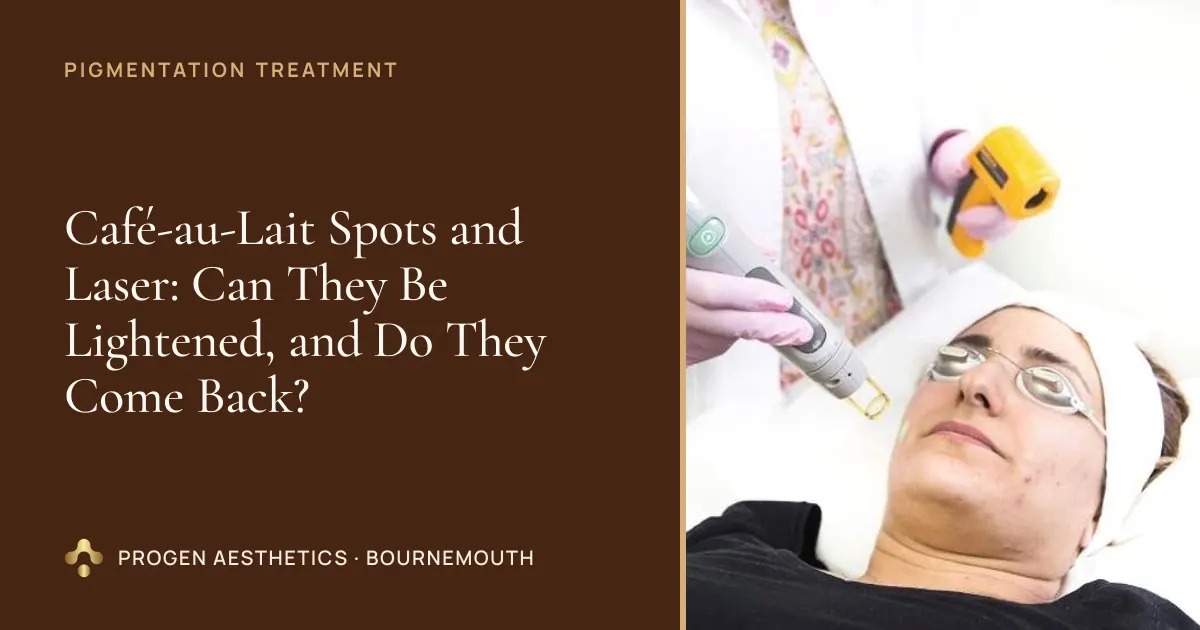
Laser can lighten some café-au-lait spots, but it does not clear every mark, and the colour can return. Studies of lasers on these marks report a wide range of results: some people clear well, some improve partly, and a minority see the spot come back or develop a lighter or darker patch afterwards. Whether a particular spot is a good candidate is something a practitioner confirms at an in-person assessment.
If you are weighing this up, start with what the mark is. Pigment treatment at a clinic is a different question from diagnosis, and our page on laser pigmentation treatment explains how a consultation fits in. This guide covers the specific case of café-au-lait spots.
What a café-au-lait spot is
A café-au-lait macule is a flat, light-to-dark brown patch with a fairly even colour. Guy's and St Thomas' describes them as flat patches that can appear anywhere on the body and may look darker on brown or black skin. Many people have one or two, and they are often present from birth or appear in childhood.
When to see a GP before thinking about laser
Several café-au-lait spots can be linked to neurofibromatosis type 1 (NF1). The NHS lists light brown patches (café-au-lait spots) among the signs of NF1 and says they may be harder to see on brown and black skin. NHS genomics education material gives the diagnostic criterion as six or more café-au-lait macules over 5 mm across before puberty, or over 15 mm after puberty. It also says the spots alone do not make the diagnosis: a person without a family history needs two or more of the listed features. The same source notes that other conditions can cause café-au-lait spots, including Legius syndrome.
Practical points:
- A child with six or more café-au-lait spots should be seen by a GP, as Guy's and St Thomas' advises.
- A new spot, a spot that is changing, raised or bleeding, or a patch you are unsure about should be looked at by your GP or a dermatologist. Our guide on getting a changing dark mark checked before laser pigmentation treatment explains why.
- Treating the colour does not change whether an underlying condition needs follow-up. Laser is a cosmetic decision made after the diagnosis question is answered.
What studies report on laser for café-au-lait spots
The evidence is a mix of small and retrospective studies, and the quality is limited.
| Source | What it looked at | What it reported |
|---|---|---|
| Systematic review and meta-analysis, 2023 (19 studies, 991 patients) | Laser for café-au-lait macules | Evidence rated very low to moderate quality. Pooled 75% clearance rate 43.3%, pooled recurrence rate 13%, hypopigmentation and hyperpigmentation each in about 1.2%. The Q-switched 1064 nm Nd:YAG laser performed best across wavelength groups. |
| Retrospective study, 2025 (116 patients) | Picosecond vs nanosecond 1064 nm Nd:YAG | Excellent clearance in 30.1% (picosecond, 83 patients) and 15.2% (nanosecond, 33 patients); the difference was not statistically significant. Among good responders, relapse was 10.3% and 22.2%. Pigment complications 16.9% and 24.2%, again not a significant difference. |
| Retrospective review, 2024 (14 patients, skin types II to VI) | 730 nm picosecond laser | Average improvement rated 26% to 50%; two patients cleared completely. Four patients had smooth-bordered lesions, and three of those improved by only 1% to 25%. Three patients had partial recurrence. |
| Scoping review, 2025 | Lasers for benign pigmented lesions | Recurrence and post-inflammatory hyperpigmentation were described as common, especially in people with darker skin tones. |
How to read this: the figures come from different designs, laser types and ways of scoring improvement, so they are not directly comparable and are not a forecast for your mark. Complication rates differ between the review (about 1.2%) and the retrospective study (about 17% to 24%), which is one reason to ask a practitioner what they would expect for your skin and your lesion.
Why results vary
- The edge of the mark. In the 2024 series the smooth-bordered lesions responded poorly. Lesion shape and where it sits on the body are things a practitioner assesses in person.
- Skin tone. The scoping review reports more recurrence and post-inflammatory pigmentation in darker skin. Several studies include darker skin types, so tone is not a bar on assessment, but it shapes how cautiously a plan is built. See our guide on pigmentation that looks darker after laser for what pigment changes can look like while healing.
- Equipment. Pigment lasers differ in wavelength and pulse length. Which device suits you is decided at consultation.
- Sun exposure. Sun protection around treatment is part of managing pigment risk; your practitioner will confirm what they advise.
Questions to ask at a consultation
- Has this mark been seen by a GP or dermatologist, and is it a typical café-au-lait spot?
- Do you recommend a small test area first, and how long would you wait to judge it?
- What would you expect for my skin tone, and what are the chances of a lighter or darker patch?
- If the colour comes back, what would you advise, and what would it cost?
- How many sessions and what spacing would you expect for this kind of mark?
If the mark does not look like a café-au-lait spot, a different guide may fit better, such as melasma and laser.
Frequently asked questions
Can laser remove a café-au-lait spot completely?
Sometimes, but not reliably. In a 2024 series of 14 patients two cleared completely, and the 2023 meta-analysis reported 75% clearance in a pooled 43.3% of treated lesions. Many people improve only partly, so complete removal should not be assumed.
Do café-au-lait spots come back after laser?
They can. The 2023 meta-analysis pooled a recurrence rate of 13%, while a 2025 retrospective study reported relapse in 10.3% to 22.2% of good responders depending on the laser. Study designs differ, so these are ranges, not a prediction.
Should I see a GP before treating a café-au-lait spot?
If a child has six or more spots, if a spot is new, changing, raised or bleeding, or you are unsure what it is, see a GP or dermatologist first. Several spots can be linked to neurofibromatosis type 1, which is diagnosed from a combination of features rather than the spots alone.
Is laser for café-au-lait spots suitable for darker skin?
Studies include people with darker skin types, but reviews report more recurrence and post-inflammatory pigmentation in darker skin. A practitioner will assess your skin and lesion and may suggest a small test area first.
Ask about laser pigmentation treatment
Sources and further information
- Meta-analysis of laser for café-au-lait macules: 19 studies, 991 patients, evidence very low to moderate quality, pooled 75% clearance rate 43.3%, recurrence 13%, hypo- and hyperpigmentation about 1.2% each, QS 1064 nm Nd:YAG best across wavelength subgroups.
- Retrospective study of 116 patients: picosecond (83) vs nanosecond (33) 1064 nm Nd:YAG; excellent clearance 30.1% vs 15.2%; relapse among good responders 10.3% vs 22.2%; complications 16.9% vs 24.2%; differences not statistically significant.
- 14 patients, skin types II to VI, 730 nm picosecond laser, average 4.3 sessions; average improvement 26% to 50%; two complete clearances; smooth-bordered lesions responded poorly; three partial recurrences; three with pigment changes.
- Scoping review of lasers for benign pigmented lesions: recurrence and post-inflammatory hyperpigmentation described as common, especially in darker skin tones.
- NHS lists light brown patches (café-au-lait spots) as an NF1 sign, which may be harder to see on brown and black skin.
- Six or more café-au-lait macules (over 5 mm before puberty, over 15 mm after) is one NF1 criterion; two or more features needed without family history; other conditions including Legius syndrome (SPRED1) can present with café-au-lait patches.
- Café-au-lait marks are flat light or dark brown patches, may look darker on brown or black skin, and a child with six or more should see a doctor.
More in pigmentation
Questions people ask next
- How to Prep Your Skin for Pigmentation Treatment in Bournemouth
- Freckles or Sun Spots: Which Marks Laser Can Lighten and Which Come Back
- Used a Skin-Lightening Cream? What to Tell the Clinic Before Laser Pigmentation Treatment
- Laser or Chemical Peel for Sun Spots and Age Spots: How They Differ
Treatment details, suitability and booking: pigmentation removal in Bournemouth. All pigmentation guides
Make an informed next step
Bring your questions
to a consultation.
A guide can help you prepare. Your assessment determines which options are appropriate for you.