
Redness & visible vessels
Rosacea on Brown or Black Skin: What It Can Look Like and Why It Gets Missed
Information to help you prepare questions. Treatment suitability, risks and aftercare are assessed individually with the clinic.
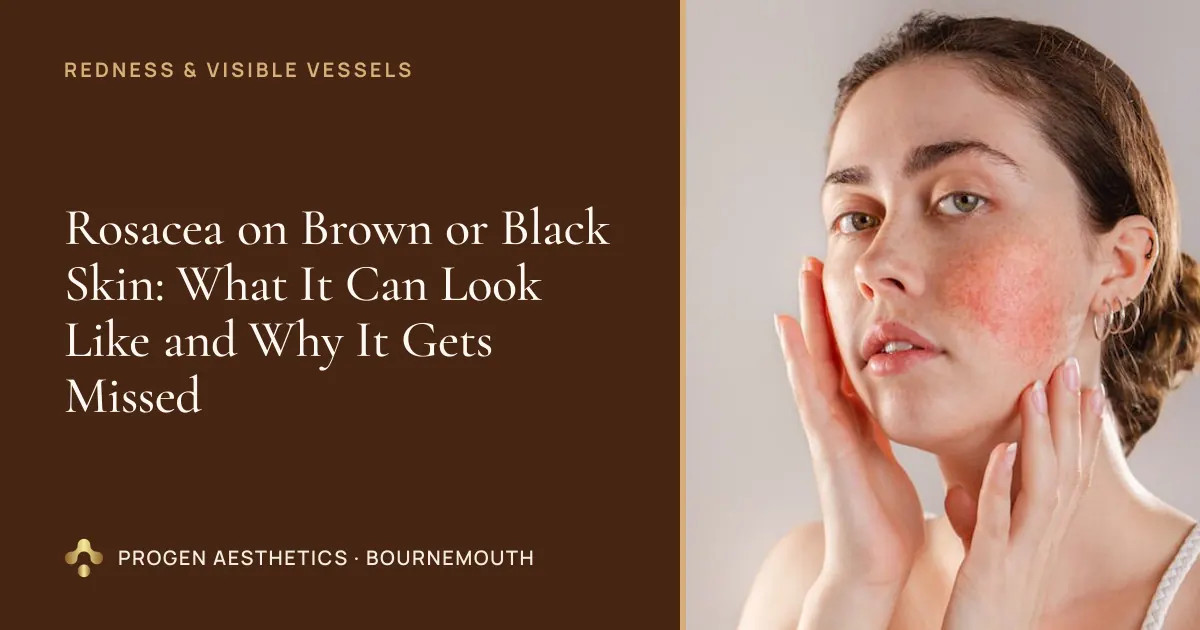
Short answer: yes, rosacea happens on brown and black skin, and it is probably missed more often there. The usual description, with obvious redness and visible tiny blood vessels, is harder to see against more pigmented skin. The NHS says that "the redness may be harder to see on brown or black skin". If you have burning, stinging, flushing or acne-like bumps on the central face that keep coming back, it is worth asking a GP about rosacea even if your skin does not look red.
This guide is general information, not a diagnosis. Only a GP or dermatologist can tell you what your skin is doing.
Why rosacea gets missed in darker skin
Rosacea is usually described through persistent redness and visible tiny vessels (telangiectasia). A 2019 review in the Journal of the American Academy of Dermatology says rosacea is reported less often in people with skin of colour, but is likely underreported and underdiagnosed, partly because redness and dilated vessels are harder to see in dark skin. It warns that delayed diagnosis can mean inadequate treatment and progression, including thickened (phymatous) skin changes.
A 2026 review in the American Journal of Clinical Dermatology makes the same point and suggests a careful symptom history, including burning, stinging, dryness and triggers, rather than relying on colour alone.
What it can look like instead
Descriptions vary, and not everyone will have all of these. Possible signs include:
| Usual description | What may be seen or felt on brown or black skin |
|---|---|
| Clear red flush on the cheeks and nose | Redness that looks brownish, purplish or violet, or is mistaken for uneven pigment |
| Visible tiny vessels | Vessels harder to see; one US clinic study found them less often recorded in patients with skin of colour (30.4% vs 49.2%) |
| Warm, hot or stinging skin | Often the clearest clue: burning or stinging, intolerance of skincare products, warmth |
| Acne-like bumps | Bumps and pustules on the central face, sometimes more noticeable than any colour change |
| Skin thickening of the nose | May show first around the nostrils; the National Rosacea Society reports this in skin of colour |
The clinic study (Gomez-Lara et al., JAAD International, 2026) is a chart review from a single San Francisco primary-care network. It is useful but not definitive. It also found rosacea diagnosed less often in patients with skin of colour (0.9% vs 1.7%), which fits the underdiagnosis picture but cannot prove it.
What else it can be mistaken for
The NHS notes rosacea can look like acne, contact dermatitis, seborrhoeic dermatitis, lupus and keratosis pilaris. The 2026 review adds periorificial dermatitis and sarcoidosis, and says rosacea's violet-toned redness can be mistaken for pigmentation.
One further point is reported by the National Rosacea Society, citing a dermatologist: skin-lightening products can contain topical steroids, and heavy use may cause redness, burning, stinging and pimples that mimic rosacea. If you use any such product, tell your doctor, and do not stop a prescribed steroid without advice.
What to bring to a GP appointment
- When it started, and what sets it off (heat, sun, alcohol, spicy food, hot drinks, stress, certain products).
- Burning, stinging or warmth, even if the skin looks normal.
- Photos taken in good light during a flare and on a calm day.
- Every product you use on your face, including lightening creams and anything with steroids.
- Any eye symptoms. The NHS says to ask for an urgent GP appointment or call 111 if you have rosacea and an eye that is painful, blurred, light-sensitive, red or gritty.
Dermatologists can use aids such as strong light against a dark background, pressing a glass slide on the skin (diascopy), or a dermatoscope. These are tools for a clinician, not something to do at home.
How it is usually treated
The NHS says rosacea cannot be cured but a GP can help control it. Options are creams or gels, or antibiotics for 6 to 16 weeks, with referral to a dermatologist if these are not working. The British Association of Dermatologists says topical treatments can take at least 8 weeks to show an effect. Daily sunscreen of SPF 30 or more and gentle skincare are NHS self-care advice.
Where light and laser treatment fits
A GP or dermatologist comes first. If redness or visible vessels remain, light-based treatment may later be discussed. The British Association of Dermatologists says redness and dilated vessels can be treated with laser therapy by a dermatologist.
Darker skin needs extra care. A 2024 review of lasers and energy devices for rosacea in skin of colour says not every device is suitable, because darker skin absorbs more energy and has a higher risk of pigment change and scarring. The 2026 review describes expert advice to avoid pulsed dye laser in the darker phototypes and IPL in the darkest, notes a 1064 nm Nd:YAG may have a better safety profile, and recommends test spots. These are review-level opinions, not a protocol for any clinic.
Progen's published suitability: the clinic's vascular lesions page states that laser treatment for facial redness is suitable for fair to light skin tones (Fitzpatrick 1 to 3). If your skin is darker than that, do not assume a light treatment is on offer. Read the rosacea and diffuse redness page and ask, before booking, whether treatment would be considered for your skin. Your practitioner will confirm.
When to see someone sooner
See a GP promptly for eye pain, blurred vision or light sensitivity (urgent, per the NHS), thickening of the nose, or a patch that is changing, bleeding or not healing. Do not book a cosmetic treatment for a mark or patch that has not been assessed.
Frequently asked questions
Can you get rosacea on black or brown skin?
Yes. Rosacea is often thought of as a condition of lighter skin, and the NHS says it is more common in people with lighter skin. But reviews describe it in people with skin of colour and say it is probably underdiagnosed because redness is harder to see.
What does rosacea look like on dark skin?
It may look brownish, purplish or violet rather than red, and tiny blood vessels may be hard to see. Burning, stinging, warmth, dryness and acne-like bumps on the central face can be the clearer signs. A GP or dermatologist needs to examine it.
Is rosacea treated differently on brown or black skin?
The NHS lists the same main options for everyone: creams or gels, antibiotics for 6 to 16 weeks, and referral to a dermatologist if needed. Light and laser treatments need more caution in darker skin because of pigment-change and scarring risk.
Can laser or IPL treat rosacea on darker skin?
Reviews say some devices may be used with care, but not all are suitable and pigment change is a real risk. Progen's vascular lesions page states laser for facial redness suits fair to light skin tones (Fitzpatrick 1 to 3), so ask the clinic before booking if your skin is darker.
Could my skin-lightening cream be causing the redness?
The National Rosacea Society reports that lightening products containing topical steroids, used heavily, can cause redness, burning, stinging and pimples that mimic rosacea. Tell your GP what you use and do not stop prescribed medicine without advice.
Read about rosacea and diffuse redness treatment at Progen
Sources and further information
- Redness may be harder to see on brown or black skin; can resemble acne, contact dermatitis, seborrhoeic dermatitis, lupus, keratosis pilaris; creams/gels or antibiotics 6 to 16 weeks; dermatologist referral; urgent GP/111 for painful, blurred, light-sensitive, red or gritty eye; daily SPF 30+ and gentle skincare; more common in lighter skin. Accessed 11 Nov 2026.
- Topicals can take at least 8 weeks; laser therapy by a dermatologist can treat redness and dilated vessels; predominantly fair-skinned but any skin type. Accessed 11 Nov 2026.
- Alexis et al., J Am Acad Dermatol 2019: rosacea reported less often in skin of colour, likely underreported and underdiagnosed partly because erythema and telangiectasia are harder to see; delayed diagnosis can lead to inadequate treatment and phymatous progression. Abstract read via Europe PMC (PMID 30240779).
- Lohani, Marson, Baldwin, Am J Clin Dermatol 2026 (open access, PMC13727955): erythema may look violaceous or brown in phototypes IV-VI and be mistaken for pigmentation; telangiectasia less visible; burning/stinging, dryness, triggers and product intolerance are diagnostic clues; mimics list; expert consensus to avoid PDL in IV-VI and IPL in V-VI, Nd:YAG may have better safety profile, test spots. Read via Europe PMC full text (first 100,000 characters).
- Chen et al., J Cosmet Laser Ther 2024: not all lasers and energy devices suit darker skin, which absorbs more energy with higher risk of pigmentation change and scarring; seven devices reviewed for Fitzpatrick IV-VI. Abstract read via Europe PMC (PMID 39171934).
- Gomez-Lara et al., JAAD Int 2026: San Francisco primary-care chart review; rosacea diagnosed 0.9% in skin of colour vs 1.7% in White patients; telangiectasia recorded in 30.4% vs 49.2%. Read via Europe PMC full text.
- National Rosacea Society (13 Mar 2023) reporting a dermatologist: lightening products with topical steroids can cause rosacea-like redness, burning, stinging and pimples; early nose thickening may show around the nostrils; diascopy and lighting aids.
More in rosacea and redness
Questions people ask next
- Make-Up for Rosacea Redness: What Dermatology Sources Say About Concealers, Colour Correctors and Skin Camouflage
- Eye Symptoms with Rosacea: Signs of Ocular Rosacea and When to See a GP or Optometrist
- Understanding and Treating Diffuse Redness
- Is Rosacea Hereditary? What Family History and Genetic Studies Show
Treatment details, suitability and booking: rosacea treatment in Bournemouth. All rosacea and redness guides
Make an informed next step
Bring your questions
to a consultation.
A guide can help you prepare. Your assessment determines which options are appropriate for you.
Continue reading: Facial Thread Veins vs Rosacea: What Is the Difference?