
Thread vein treatment
How many laser sessions do thread veins usually need, and why it varies
Information to help you prepare questions. Treatment suitability, risks and aftercare are assessed individually with the clinic.
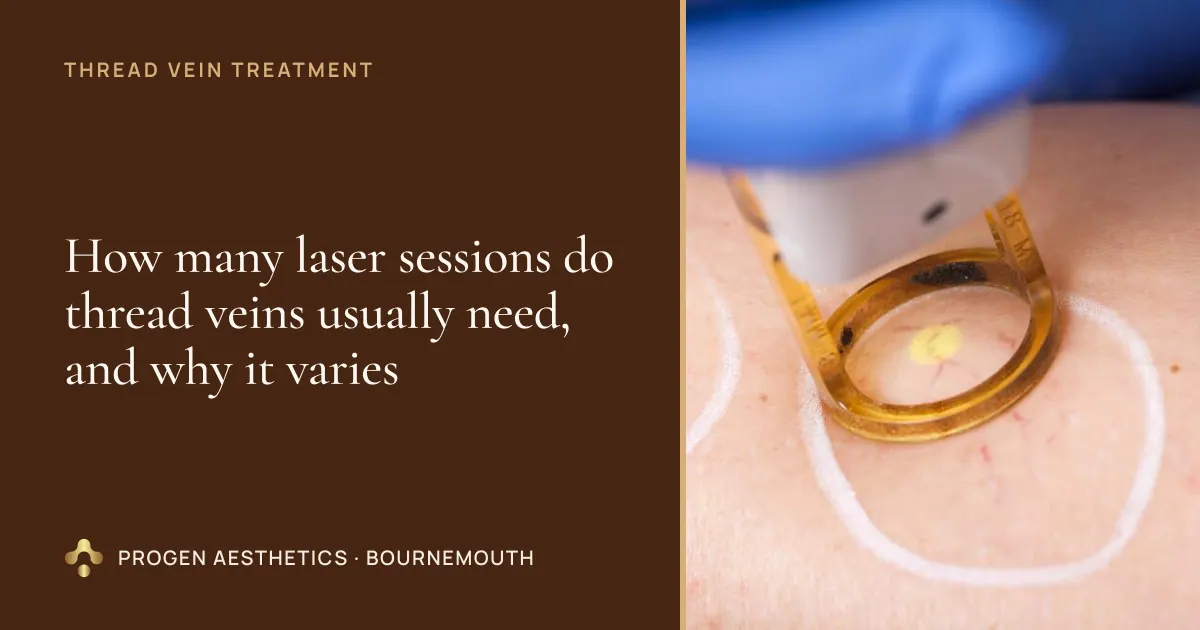
There is no single number. For thread veins, published trials scheduled two or three laser sessions several weeks apart, a large facial series averaged just over two, and clinics quote anything from one session to five or more. Your practitioner can only estimate your course after looking at your vessels, so treat any fixed figure given before an assessment with caution. (Evidence checked as of 8 November 2026.)
This guide sets out what the research and the published clinic and NHS information actually say about session counts, why people differ, and what to ask so that you know what a course includes before you start.
What do studies say about the number of sessions?
Most trials fix the number of sessions in advance, so a trial's schedule shows what researchers chose to test, not how many each person needed. Read them as a guide to scale, not a prediction.
| Evidence | Area and device | Sessions | What it found |
|---|---|---|---|
| Randomised split-face trial, 39 completers (Nymann et al., 2010) | Face: long-pulsed dye laser vs intense pulsed light (IPL) | 3 of each, 6 weeks apart | Good or excellent response in 30 of 39 people with both devices; excellent clearance (75–100%) in 18 (46%) with the dye laser vs 11 (28%) with IPL |
| Case series of 1,000 patients (Aesthetic Plastic Surgery, 2006) | Face: one IPL system | Mean 2.16 (range 1–9) | 89.7% reached 75–100% clearance on photograph comparison; results related to operator experience rather than lesion size |
| Randomised trial, 56 women (Parlar et al., 2015) | Legs: Nd:YAG laser vs foam sclerotherapy | 2, 6 weeks apart | Sclerotherapy improved faster, but final clearance did not differ; laser was more painful |
| Randomised trial, 285 women (Ianosi et al., 2019) | Legs: Nd:YAG laser, polidocanol, saline | 2, 60 days apart | Good or very good results at 120 days in 95% of vessels under 1 mm with laser vs 53% with polidocanol; over 1 mm, no difference between laser and polidocanol could be shown |
Three things follow from this table.
- Short courses were enough to produce measurable improvement in these studies, but "improvement" was usually scored from photographs and, in the larger leg trial, assessed only up to 120 days.
- Vessel size mattered in the leg trial. Laser did best on vessels under 1 mm. The authors did not find a difference from polidocanol for vessels over 1 mm. This was one single-centre trial of women, with about 14% lost to follow-up, so it suggests a pattern rather than a rule.
- The facial IPL series is not a promise for every device. It used one IPL system and was a single-centre series assessed by photographs. Progen's treatment page describes a different laser, so its numbers should not be read across.
A Cochrane review of lower-limb thread and reticular vein treatments (searches to 16 March 2021) found no clear difference in vein resolution between laser and sclerosing injections, with moderate certainty. None of the included studies assessed recurrence, so how long results last remains an open question. Cochrane summary.
What do clinics and health services quote?
Clinic pages are marketing and rarely cite studies, so use them to understand what you may be told, not as evidence.
| Source | Wording on number of sessions |
|---|---|
| North Bristol NHS Trust, facial thread veins (published March 2025) | "You may need several treatment sessions", with no figure given |
| American Academy of Dermatology, leg veins | Laser: "3 or more treatments" for complete clearing; sclerotherapy: "2 or 3" |
| Skin and Spirit | 3 sessions, 4 weeks apart "to achieve good results", with more possible |
| Laser Skin Solutions, Bournemouth | "2 treatments or possibly more", about four weeks apart, estimated at consultation |
| Healthline | Often significant improvement after one session; full removal "up to five or six" (article dated 2023) |
| Vein Treatment Clinic | "4 sessions or more" for laser, from a clinic that promotes sclerotherapy |
The spread, from one session to six, is itself informative. The figures reflect different devices, different vessels and, in some cases, a different commercial interest. A page that gives one number for everyone is describing a typical case, not yours.
Why does the number vary?
These are the factors that sources repeatedly give, and none of them can be judged from a photograph.
- Vessel size and depth. DermNet notes that blue vessels respond less well to light treatment than red ones because of their colour, larger diameter and depth in the skin, and may be better treated by sclerotherapy. (DermNet; a long-established educational page, not a trial.) The Ianosi trial points the same way for vessel diameter.
- Treatment area. Face and legs are not interchangeable. The AAD quotes different counts for laser and injections on legs, and the trials above used different schedules for face and legs.
- How many vessels there are. Several clinic pages say that larger or more extensive areas take more sessions. Progen's own page says the number "varies based on the size and type of vessels".
- The device and settings. In the split-face trial, the dye laser outperformed IPL on the same faces for excellent clearance, so "laser" and "IPL" are not one category.
- Your skin and recent sun exposure. Some clinics decline to treat tanned skin and plan around it. Your practitioner will confirm what applies to you.
- New vessels forming. Treating the vessels you have does not stop new ones appearing. The AAD notes that veins become more common with age and pregnancy, and that family history and long periods of sitting or standing raise the risk. Progen's page mentions maintenance sessions for new vessels. Plan for the possibility that "finished" is not permanent.
If your concern includes general redness or flushing as well as individual vessels, the number of sessions will depend on which of these is being treated. Our guide to facial thread veins versus rosacea explains that separate question.
How long should you wait before judging a session?
Results appear gradually. The AAD says small spider veins may fade soon after laser treatment, while larger veins darken and can take about one to three months to disappear. Judging too early can lead to a session being repeated before the last one has finished working. The trials above waited 6 to 8 weeks between sessions and assessed results some time after the last one. Your practitioner should tell you when they will review progress and what would change the plan.
Aftercare also affects scheduling. North Bristol NHS Trust advises looking after the skin for two to three weeks after each appointment and says you may need high-factor sunscreen for the whole course. It also describes a week of purple bruising after pulsed dye laser. Ask your practitioner what to expect from the device they use.
What to ask before agreeing to a course
- What is the estimated number of sessions for my vessels, and what range is realistic?
- How far apart will sessions be, and when will we review whether another is needed?
- Is the price per session, per area or per course, and what happens if I need more or fewer?
- What counts as an acceptable result, and what would we do if progress is slow?
- If new vessels appear later, what would follow-up involve and cost?
- Are there reasons to see a GP or have other assessment before cosmetic treatment, especially for leg veins that ache, swell or are changing the skin?
Next step
Progen's vascular lesions and small vessels page describes laser treatment for selected vessels on the face, body and legs and how to arrange a consultation in Bournemouth. A practitioner can assess your vessels and give you an individual estimate; it is not possible to give one from an article. For current fees, see Progen's prices or confirm at consultation.
Frequently asked questions
Can thread veins be cleared in one laser session?
Sometimes small vessels improve after a single session, and some clinics and health sites say many people improve significantly after one. Trials, though, scheduled two or three sessions, and a large facial series averaged just over two. Whether one is enough depends on the vessels, and your practitioner will advise after assessment.
How far apart are laser sessions for thread veins?
The trials found used gaps of 6 weeks to 60 days, and clinic pages commonly say about four weeks. Progen's treatment page says sessions are usually a few weeks apart. Your practitioner will set the interval for your skin and the device used.
Do I need more sessions for leg thread veins than facial ones?
Not necessarily, but they are planned differently. The American Academy of Dermatology quotes 3 or more laser treatments for complete clearing on the legs, while facial figures vary between sources. Vessel size and extent matter more than the area alone.
Will thread veins come back after a full course?
Treated vessels may clear, but new ones can form, and the Cochrane review found no included study that measured recurrence. Ask what follow-up and maintenance would involve before you start.
Explore Progen’s vascular lesions and small vessels laser treatment
Sources and further information
- Accessed 2026-11-08. Nymann, Hedelund, Haedersdal, JEADV 2010;24(2):143-146: split-face randomised trial, 40 enrolled/39 completed, 3 long-pulsed dye laser and 3 IPL treatments at 6-week intervals; excellent clearance 18 (46%) LPDL vs 11 (28%) IPL (P=0.01); both gave good/excellent response in 30 of 39.
- Accessed 2026-11-08. Aesthetic Plastic Surgery 2006;30(2):226-232: 1,000 consecutive patients (Fitzpatrick I–IV) treated with one IPL system; mean 2.16 treatments (range 1–9); 89.7% achieved 75–100% clearance by photograph; results correlated with operator experience, not lesion size, age or skin type; minor side effects in 14.6% of patients.
- Accessed 2026-11-08. Parlar et al., JEADV 2015;29(3):549-554: 56 women, one leg Nd:YAG and the other foam polidocanol 0.5%, two sessions 6 weeks apart; faster improvement with sclerotherapy but no difference in final clearance; laser significantly more painful; laser suits needle phobia, sclerosant allergy or small veins with matting.
- Accessed 2026-11-08. Ianosi et al., Experimental and Therapeutic Medicine (2018/2019): 285 women, long-pulsed Nd:YAG vs 0.5% polidocanol vs hypertonic saline, two sessions 60 days apart; at 120 days good/very good results for vessels under 1 mm: laser 95.05%, polidocanol 52.80%; over 1 mm laser 82.14%, polidocanol 86.25% with no demonstrated difference between them.
- Accessed 2026-11-08. Cochrane review published 12 October 2021, searches to 16 March 2021: no clear difference in resolution between laser and sclerosing agents (moderate certainty); no included study assessed recurrence.
- Accessed 2026-11-08. NHS service page (edition March 2025, review due March 2028): several sessions may be needed; about a week of purple bruising after pulsed dye laser; look after skin for two to three weeks after each appointment; high-factor sunscreen may be needed through the course.
- Accessed 2026-11-08. Laser '3 or more' treatments for complete clearing, sclerotherapy '2 or 3'; small spider veins may fade right after treatment, larger veins darken and can take about 1–3 months to disappear; age, pregnancy, family history and prolonged sitting/standing raise vein risk.
- Accessed 2026-11-08. Blue vessels respond less well to light or laser because of colour, larger diameter and depth, and sclerotherapy may suit them better; extensive facial veins usually need several sessions about a month apart.
- Accessed 2026-11-08. Progen states the number of sessions varies with the size and type of vessels, sessions are usually a few weeks apart, response time varies, and maintenance sessions may be recommended for new vessels; consultation via contact team or booking portal.
More in thread veins
Questions people ask next
- Facial Thread Veins vs Rosacea: What Is the Difference?
- What Thread Veins Look Like After Laser: Bruising, Darkening and Fading
- Can Thread Veins or Rosacea Redness Be Treated on the NHS? What Dorset and Other Areas Say
- Leg Thread Veins or Varicose Veins? What to Check Before Laser
Treatment details, suitability and booking: thread vein removal in Bournemouth. All thread veins guides
Make an informed next step
Bring your questions
to a consultation.
A guide can help you prepare. Your assessment determines which options are appropriate for you.