Thread vein treatment
Can Thread Veins or Rosacea Redness Be Treated on the NHS? What Dorset and Other Areas Say
Information to help you prepare questions. Treatment suitability, risks and aftercare are assessed individually with the clinic.
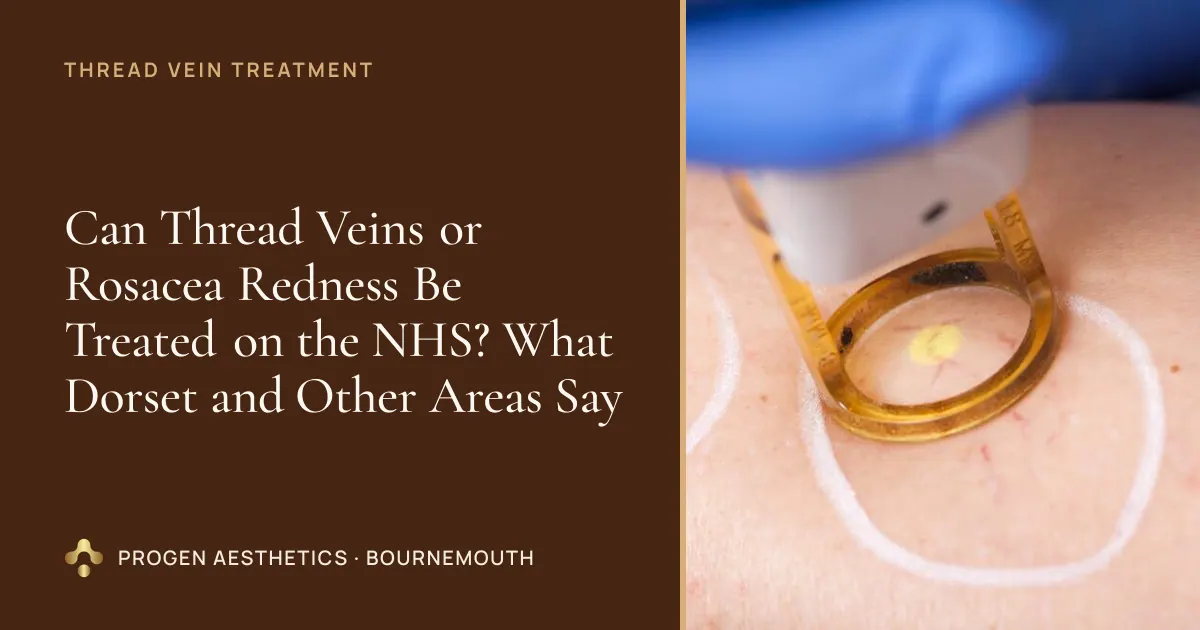
Short answer: treatment aimed at how facial thread veins or rosacea redness look is generally not routinely funded on the NHS. NHS Dorset's own policy says it "does not routinely fund cosmetic procedures" and that "there are no qualifying access criteria" for them. Exceptions exist but are narrow and are decided case by case, so ask your GP before assuming either way. Rosacea itself is a different matter: its medical treatment is available through your GP. (Policy wording checked 21 November 2026.)
If you are weighing up thread vein removal in Bournemouth as a private option, the rest of this guide explains what the NHS documents actually say, where the word "cosmetic" stops applying, and what to ask at each step.
What the NHS pages say, in plain terms
| Source | What it says | Scope |
|---|---|---|
| NHS Dorset Clinical Policy: Cosmetic Procedures (v1.0, issued 31 October 2025, review due 2028) | "NHS Dorset does not routinely fund cosmetic procedures. There are no qualifying access criteria for cosmetic procedures." Its list of cosmetic procedures includes "Laser skin treatments" and "Facial blushing/Erythrophobia", and says the list "is not exhaustive". | Applies to NHS Dorset patients only |
| NHS Dorset Clinical Policy: Removal of Benign Skin Lesions | Lists "spider naevi (telangiectasia)" among benign lesions. Treatment "is not usually offered by the NHS if it just to improve appearance"; a lesion must meet at least one listed criterion, such as bleeding more than twice weekly for at least four weeks during everyday activity. | Applies to NHS Dorset patients only |
| North Bristol NHS Trust, Bristol Laser Centre | "Laser treatment for facial threadveins is not routinely funded on the NHS." The same trust says the same of laser for rosacea. In both cases an area Exceptional Funding Panel "may consider" unusually severe conditions or exceptional circumstances, and it advises speaking to your GP. | Bristol-area example, not Dorset |
| NHS Scotland national referral protocol (thread veins) | Treatment "is only supported for such as severe erythrotelangiectatic rosacea or arborising telangectasia", judged by a regional vetting panel, with formal photography and a maximum of 6 sessions after assessment. "Treatment for facial flushing or mild background erythema is not offered." | Scotland only; shows how narrow a funded pathway can be |
| NHS website, varicose veins | "Treatment to improve how varicose veins look is not usually available on the NHS if they're not causing any other problems." It also says "You may be able to pay for it privately." | Leg varicose veins, not facial veins |
Two honest limits on this table. First, the Dorset policies do not name facial thread veins or rosacea redness in so many words: the cosmetic list names laser skin treatments and facial blushing, and the benign-lesions list uses the term "spider naevi (telangiectasia)". How a particular request is judged is for the NHS to say, not for this article. Second, other areas set their own rules, so the Bristol and Scottish documents show a pattern, not a Dorset promise.
When "cosmetic" may not be the right word
Thread veins on the face can look similar to other things, and a changed appearance is not always a cosmetic matter. The Dorset benign-lesions policy itself says multiple lesions "may be a sign of underlying disorders", and that is a reason to have a new or unusual change looked at rather than treated. Our guides on thread veins on the nose and cheeks and when to see a GP first and on leg thread veins or varicose veins before laser treatment cover what to raise with your GP. Leg veins in particular can sit alongside a medical vein problem, and the NHS varicose-veins information separates them from thread veins.
If your redness is rosacea, the NHS rosacea page says a GP can prescribe creams, gels or antibiotics and may refer you to a dermatologist if those are not working. That page records a review date of 17 March 2023 with the next review due March 2026, so it was due for review at the time of writing; check it again for any change. Our piece on facial thread veins vs rosacea explains how the two are told apart, and laser treatment for facial redness is covered under laser treatment for facial redness.
How an exception request works (Dorset)
The Dorset policies say that where a patient does not meet the criteria, the Individual Patient Treatment policy "recognises that there will be occasions" when exceptions are appropriate, and the requesting clinician must supply the supporting information. Two points from the policy matter most:
- The request comes from a clinician, not from you directly. The requesting clinician supplies the evidence.
- Likely benefit is not enough. The policy states that "the fact that treatment is likely to be effective for a patient is not a basis for exceptional circumstances"; there must be an unusual or unique clinical factor that makes the person significantly different from others with the same condition.
In practice, that means that wanting veins gone, or even a good chance that laser would work, would not on its own be treated as exceptional. Your GP can tell you whether anything in your situation might.
If you decide to go private
A private consultation is where suitability is assessed, so it is reasonable to ask before booking:
- Who assesses the area? Ask how the clinic checks that what you have is what it appears to be, and what happens if it needs a GP or dermatology opinion first.
- What are the options for my veins? Laser and sclerotherapy suit different sizes, colours and sites; see laser vs sclerotherapy for thread veins.
- How many sessions, and what is the total? One clinic page we read says "you may need several treatment sessions", and another trust page lists a separate consultation fee from the per-session price. Your practitioner will confirm the plan for you after assessment; see how many laser sessions thread veins usually need.
- What will healing look like? Ask what to expect in the days afterwards.
No clinic can promise that veins will not return or guarantee a result, and you should be wary of any page that does.
Next step
If you would like the veins assessed with private treatment in mind, start with our thread vein treatment information and bring your questions to a consultation. If anything about the area is new, changing, painful or bleeding, speak to your GP first.
Frequently asked questions
Is laser treatment for facial thread veins available on the NHS?
Generally not routinely. North Bristol NHS Trust states laser for facial thread veins is not routinely funded, and NHS Dorset's policy says it does not routinely fund cosmetic procedures. Exceptions are considered case by case, so ask your GP.
Does NHS Dorset fund thread vein removal?
NHS Dorset's Cosmetic Procedures policy (issued 31 October 2025) says cosmetic procedures are not routinely funded and there are no qualifying criteria. Its benign skin lesions policy lists spider naevi (telangiectasia) and says treatment is not usually offered if it is just to improve appearance. Neither policy names facial rosacea redness explicitly, so your GP is the person to confirm how your case would be treated.
Can a GP help with rosacea even if laser is not funded?
Yes. The NHS rosacea page says a GP can prescribe creams, gels or antibiotics and may refer you to a dermatologist if these are not working. Laser is a separate question and is not described on that page.
What is an exceptional funding request?
A route for patients who do not meet the usual criteria. In Dorset the requesting clinician must show an unusual or unique clinical factor; the policy says that likely effectiveness alone is not enough.
Should I see a GP before booking private thread vein treatment?
It is sensible if the area is new, changing, painful, bleeding or accompanied by other symptoms, or if the veins are on your legs. A private practitioner will also assess suitability at consultation and will tell you if a medical opinion is needed first.
Find out about thread vein treatment at Progen
Sources and further information
- NHS Dorset does not routinely fund cosmetic procedures and there are no qualifying access criteria; list (non-exhaustive) includes laser skin treatments and facial blushing/erythrophobia; exceptions need an unusual or unique clinical factor, likely effectiveness is not a basis; document issued 31 October 2025, version 1.0, review October/July 2028 (the document shows both dates).
- Lists 'spider naevi (telangiectasia)' as a benign lesion that must meet at least one criterion (e.g. bleeding more than twice weekly for at least four weeks); treatment 'not usually offered by the NHS if it just to improve appearance'; multiple lesions may be a sign of underlying disorders.
- NHS Dorset clinical policy index lists 'Cosmetic treatments' and the Individual Patient Treatment Policy v9.1; used to locate the policy PDFs.
- Laser for facial threadveins is not routinely funded on the NHS; Exceptional Funding Panel may consider unusually severe conditions or exceptional circumstances; GP discussion advised; private from £150 per session, consultation £120; several sessions may be needed; review due March 2028.
- Laser for rosacea is not routinely funded on the NHS; panel may consider severe or exceptional cases; edition April 2025, review due April 2028.
- NHS Scotland supports treatment only for conditions such as severe erythrotelangiectatic rosacea or arborising telangiectasia, via a regional vetting panel, with photography and a maximum of 6 sessions; facial flushing or mild background erythema not offered.
- Treatment to improve how varicose veins look is not usually available on the NHS if they are not causing other problems; may be paid for privately; thread veins described as usually harmless and different from varicose veins; page reviewed 1 July 2024, next review 1 July 2027.
- GP can prescribe creams, gels or antibiotics and may refer to a dermatologist if treatments are not working; page does not mention laser or funding; last reviewed 17 March 2023, next review due 17 March 2026.
- Context only: a private provider FAQ states thread veins are generally considered cosmetic and not typically NHS-available unless complications such as leg ulcers, significant swelling or skin changes.
More in thread veins
Questions people ask next
- Thread Veins on the Nose and Cheeks: Common Causes and When to See a GP First
- Facial Thread Veins vs Rosacea: What Is the Difference?
- Cherry angioma, spider angioma or venous lake: how to tell small red marks apart before treatment
- How many laser sessions do thread veins usually need, and why it varies
Treatment details, suitability and booking: thread vein removal in Bournemouth. All thread veins guides
Make an informed next step
Bring your questions
to a consultation.
A guide can help you prepare. Your assessment determines which options are appropriate for you.