
Thread vein treatment
Red Marks After Acne: Post-Inflammatory Erythema or Pigmentation, and Where Laser Fits
Information to help you prepare questions. Treatment suitability, risks and aftercare are assessed individually with the clinic.
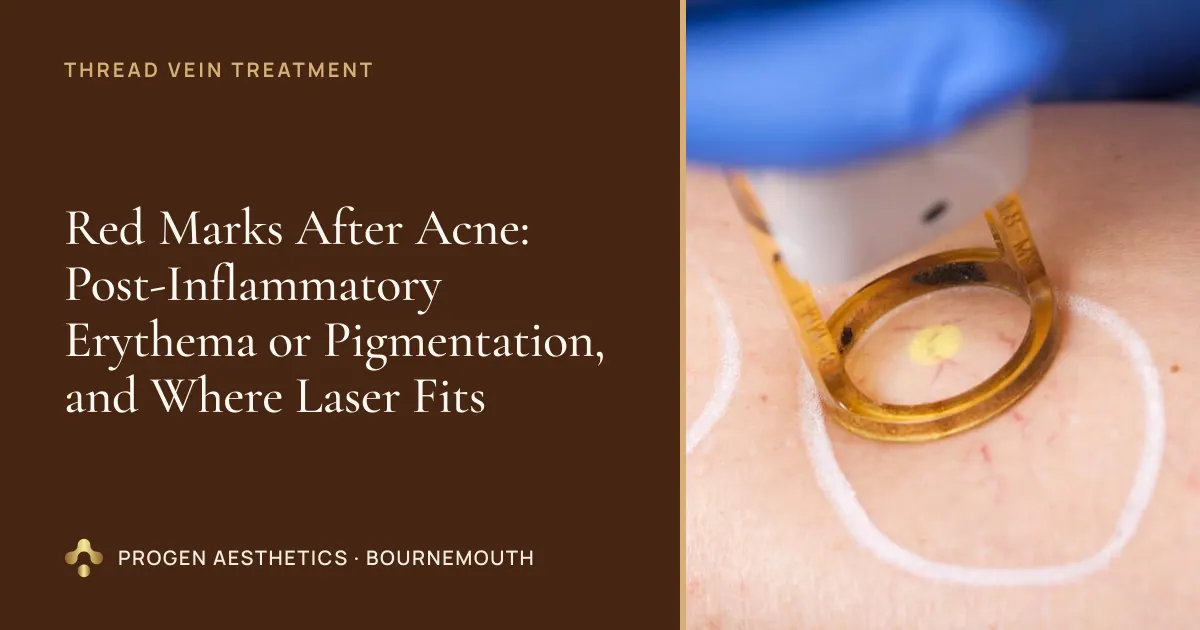
Short answer: flat red, pink or purple marks left after a spot has healed are usually called post-inflammatory erythema (PIE). They are a different problem from brown or grey marks (post-inflammatory hyperpigmentation, PIH) and from pitted or raised scars, and the evidence for laser differs for each. As of 22 November 2026, the research on light and laser treatment for post-acne redness is mostly small studies, not large trials, so it is a reasonable thing to discuss at a consultation, not a promise of a result.
Red marks come from the small blood vessels in the skin, which is why the nearest match at Progen is laser treatment for thread veins and other small vessels. That page lists thread veins, angiomas and broken capillaries, not post-acne marks, so whether a particular mark is suitable is something to ask at consultation.
Red, brown or scar: which kind of mark is it?
| Post-inflammatory erythema (PIE) | Post-inflammatory hyperpigmentation (PIH) | Acne scar | |
|---|---|---|---|
| Usual colour | Red, pink or purple | Brown, grey or dark | Can be red, darker or paler than surrounding skin |
| What is behind it | Small blood vessels after inflammation | Extra pigment (melanin) after inflammation | Change in skin structure: raised or indented |
| Texture | Flat | Flat | Raised, or pitted and indented |
| Where the evidence sits | Pulsed dye laser, intense pulsed light (IPL), Nd:YAG laser in small studies | Topical treatment first; laser usually second-line | Different treatments again, such as resurfacing or microneedling |
The British Association of Dermatologists' acne leaflet (last updated July 2024) says acne can leave marks that are red, darker or lighter than normal skin, and that scars can be raised or indented. Marks can also overlap: the two kinds of discolouration can be present together, and on deeper skin tones a red mark can look brown, so colour alone can mislead. A clinician looking at the skin in person is the reliable way to tell them apart.
Will red acne marks fade on their own?
Often they do slowly, but no source I read gives a dependable timeline. Consumer skincare pages quote anything from weeks to a year or more, without citing evidence. Two studies of intense pulsed light only enrolled people whose post-acne redness had already lasted at least six months, which suggests that persistent marks are common enough to be studied.
What helps in the meantime is mostly about not making things worse: keeping active acne under treatment, not picking, and daily sun protection. Ask your pharmacist, GP or a dermatologist about the acne itself. The NHS and local NHS trusts do not generally fund treatment for the marks, but a skin camouflage service may be available through a GP referral in some areas, and policies vary by area.
What the evidence says about laser and light for red marks
- Overview. A 2022 systematic review of post-acne erythema treatment (Kalantari and colleagues) found 18 eligible studies. Light and laser devices were the most used, with pulsed dye laser most common, followed by Nd:YAG. Some topical agents, including oxymetazoline, tranexamic acid and brimonidine, were also described as promising. The authors reported no severe side effects but said there is no gold-standard treatment and that randomised trials are needed.
- Pulsed dye laser. The term PIE was proposed in a 2013 paper that described improvement with pulsed dye laser in a handful of patients, but the authors state it presents only anecdotal cases.
- Intense pulsed light. A 2022 retrospective study of 60 patients whose marks had lasted over six months used three to seven IPL sessions four to six weeks apart. Forty-nine of 60 (81.7%) had complete or partial clearance on a global assessment scale, and seven (11.7%) had acne relapse at follow-up. It had no comparison group. A 2023 prospective study of 60 patients compared two IPL filters with no treatment; it found a vessel-targeting filter worked better than a broad-spectrum one, and reported adverse effects including pigment change and blistering in some people.
- Nd:YAG laser. A 2024 study of 48 patients found Nd:YAG laser plus low-dose oral isotretinoin improved erythema more than isotretinoin alone. It tells us little about Nd:YAG used by itself.
In short, the studies point in a consistent direction, but they are small, mostly from single centres, and use different devices and settings. Results from one device cannot be assumed for another.
One NHS-linked UK laser service (Bristol Laser Centre) says pulsed dye laser can help fade red marks left by acne spots but will not remove pits or craters. It says most people have two to three sessions three to four weeks apart, that benefits may fade after a few months, and that colour changes can occasionally occur, more often on tanned skin. It also says the treatment may not suit very dark skin, and that laser for acne is not routinely funded on the NHS.
Brown marks: why laser is usually not the first step
For post-inflammatory hyperpigmentation, a 2023 review of laser treatments in skin of colour (Sowash and Alster) concludes that lasers are second-line after topical treatment because response varies, cost is higher and complications are possible. A 2024 systematic review of 48 studies covering 1,356 people with skin of colour found no treatment with robust efficacy across the board, and some people got worse after treatment. For how brown marks are told apart and treated, see melasma vs sun spots vs post-inflammatory hyperpigmentation.
Questions to ask before booking light or laser for acne marks
- Is this mark red, brown, a scar, or a mix, and how do you tell on my skin tone?
- Is my acne settled enough to treat? Treating inflamed or irritated skin is something the practitioner will need to decide.
- Which device would be used, what evidence supports it for this kind of mark, and how many sessions are usually planned?
- What is the risk of colour change on my skin, particularly if I have tanned recently or have deeper skin?
- Are there prescribed medicines or skincare I should tell you about? Do not stop or change anything prescribed without speaking to your prescriber.
- What is the total cost, including consultation and any top-up sessions? Progen's prices page lists current fees for the treatments it offers.
Progen's own vascular page says treatment of vascular lesions suits Fitzpatrick skin types 1 to 3, and that no particular outcome is guaranteed, so suitability depends on your skin and the mark.
If your redness is not from acne
Persistent redness without a clear history of spots may be something else, such as rosacea or visible small vessels. Our guides on facial thread veins vs rosacea and on thread veins on the nose and cheeks explain how those are told apart and when to see a GP first. If you have already decided on vessel-targeting laser, how many laser sessions for thread veins explains why session numbers vary.
Frequently asked questions
Is post-inflammatory erythema a scar?
Not in the structural sense. PIE is a flat red, pink or purple mark linked to small blood vessels after inflammation, whereas scars are raised or indented changes in the skin's structure. The two can occur together, and a clinician can tell which you have.
Do red acne marks go away on their own?
Often they fade slowly, but sources I read gave no dependable timeline, and consumer estimates were unsourced. Two studies of IPL enrolled people whose marks had already lasted at least six months, so some marks clearly persist. Keeping acne under treatment, not picking and daily sun protection are the usual advice.
Can laser remove red acne marks?
Small studies of pulsed dye laser, intense pulsed light and Nd:YAG laser report improvement in post-acne redness, and a 2022 systematic review found no severe side effects, but it also said randomised trials are needed. Results are not guaranteed, and laser does not remove pitted scars.
Is treatment for acne marks available on the NHS?
Laser for acne marks and scars is generally not routinely funded on the NHS, though policies vary by area and a GP can advise. Skin camouflage may be available through referral in some places.
Is laser a good option for brown marks after acne?
Reviews of post-inflammatory hyperpigmentation in skin of colour describe topical treatment as first-line and laser as second-line, because response varies and complications such as colour change are possible.
Read about laser treatment for small vessels and arrange a consultation
Sources and further information
- Kalantari et al. 2022 systematic review of post-acne erythema treatment: 18 eligible studies from 5,796 retrieved; light and laser devices most used, pulsed dye laser most common then Nd:YAG; oxymetazoline, tranexamic acid and brimonidine described as promising; no severe side effects; no gold-standard treatment; randomised trials needed.
- Bae-Harboe and Graber 2013 proposed the term postinflammatory erythema and reported improvement with pulsed dye laser; the authors state the paper presents only anecdotal cases.
- Wu et al. 2022 retrospective study: 60 patients with acne PIE/PIH lasting over six months, 3-7 IPL sessions 4-6 weeks apart; 49/60 (81.7%) complete or partial clearance; 7 (11.7%) acne relapse; no long-term side effects reported.
- Al-Quran et al. 2023 prospective study of 60 patients with post-acne erythema of at least 6 months: vessel-targeting IPL filter effective and better than broad-spectrum filter on satisfaction, quality-of-life score and relapse; adverse effects including pigment change and blisters reported with 590 nm treatment.
- Albalat et al. 2024: 48 patients; long-pulsed Nd:YAG plus low-dose isotretinoin improved post-acne erythema more than isotretinoin alone.
- Sowash and Alster 2023 review: for post-inflammatory hyperpigmentation in skin of colour, lasers are second-line to topical agents because of variable response, cost and complication risk.
- Mar et al. 2024 systematic review: 48 studies, 1,356 people with skin of colour and PIH; topical retinoids and laser most common; no treatment showed robust efficacy across modalities; some patients worsened.
- Bristol Laser Centre (NHS trust service): pulsed dye laser can help fade red acne marks but not pits; typically 2-3 sessions 3-4 weeks apart; benefits may fade after a few months; pigment changes occasionally, more often on tanned skin; may not suit very dark skin; laser for acne not routinely funded on the NHS. Accessed 22 November 2026.
- BAD acne patient leaflet (updated July 2024, next review July 2027): acne can leave red, darker or lighter marks; scars can be raised or indented; pigmentation changes can remain; skin camouflage can disguise them; most scar treatments are not routinely NHS available. Accessed 22 November 2026.
More in thread veins
Questions people ask next
- Laser vs Sclerotherapy for Thread Veins: Face or Legs?
- Cherry angioma, spider angioma or venous lake: how to tell small red marks apart before treatment
- Leg Thread Veins or Varicose Veins? What to Check Before Laser
- Thread Veins on the Nose and Cheeks: Common Causes and When to See a GP First
Treatment details, suitability and booking: thread vein removal in Bournemouth. All thread veins guides
Make an informed next step
Bring your questions
to a consultation.
A guide can help you prepare. Your assessment determines which options are appropriate for you.